The best way to plan an outdoor kitchen is to start with how you cook and entertain, then work backward to the layout, the utilities, and the equipment. Decide early whether you will run on propane or a natural gas line, and whether you want a sink or refrigeration, because those choices set where the kitchen can go and how much work the build involves. After that, the big decision is whether a modular island or a custom built island fits your yard and budget. The grill comes last, chosen to fit the kitchen rather than the other way around.
Here is how to work through each step so the finished space gets used every week, not just on holidays.
Start with how you will actually use it
Before you look at a single island, answer three questions. How often will you cook outside, and for how many people? Do you mostly grill, or do you want to smoke, bake pizza, or cook full meals out there? And do you want guests gathered around the cook, or seated at a separate table nearby?
A couple who grills a few nights a week needs a very different setup than a household that hosts a dozen people every weekend. Answering honestly keeps you from paying for features you will not use, or worse, building a kitchen that is too small for the way you entertain.
Plan the layout in zones
Indoor kitchens are planned around work zones, and outdoor kitchens work the same way. Thinking in four zones keeps the space efficient:
- Hot zone: the grill, plus any side burner or second cooker.
- Cold zone: an outdoor rated refrigerator or beverage center, if you want one.
- Wet zone: a sink, if you are willing to run water and drainage to it.
- Dry zone: open counter for prep and plating.
The single most common mistake is too little counter space. Plan landing space on both sides of the grill so you have somewhere to set down a platter of raw food on one side and finished food on the other. If you want people to gather while you cook, a raised bar counter on the guest side of the island lets them sit close without standing in your way.
Sort out utilities before you choose a spot
Fuel. Propane is the simplest start, since tanks sit inside or beside the island and nothing needs to be trenched. A natural gas line means you never run out mid cook, but it has to be run from your home’s supply by a licensed professional, which affects both cost and where the kitchen can sit. Many gas grills can be set up for either fuel, so confirm the configuration before you order.
Power. Lighting, a refrigerator, a rotisserie, and some grill controls all need electricity. Plan outdoor rated outlets at the island rather than relying on extension cords.
Water. A sink is the feature that changes the scope of a project the most, because it needs both a supply line and somewhere for the water to drain. If you want one, plan it from day one. If you can live without it, your options open up considerably.
Permits for gas, electrical, and plumbing work vary by city, so check with your local building department before work begins.
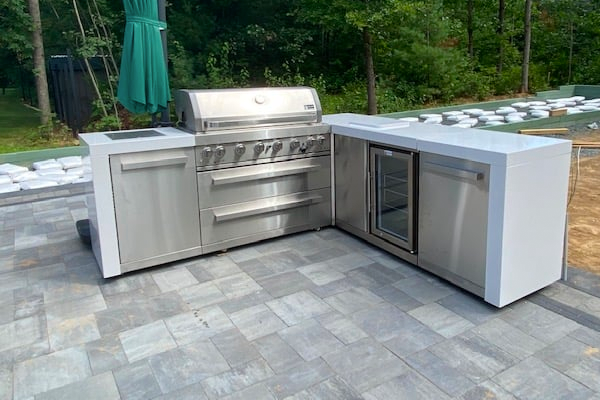
Modular island or custom build?
Once you know your layout and utilities, you can pick the island itself. Most outdoor kitchens fall into one of two approaches.
A modular island is built from finished sections, such as a grill station, a cabinet, a refrigerator or beverage module, and corner pieces, that join together into one run. Mont Alpi is known for this approach: stainless steel modular islands that arrive largely assembled, so you skip most of the construction. You can start with a grill island and add modules later as your plans grow.
A custom island is built in place, usually from masonry, stone, or another finished material, with a built in grill head and components set into it. It can be shaped to fit any space and finished to match your house or hardscape. The tradeoff is time and cost, since it involves a contractor and a full construction project. Fire Magic is a common choice for the built in grill at the center of a custom island.
| Modular island | Custom built island | |
|---|---|---|
| Timeline | Days, mostly delivery and setup | Weeks, depending on design and contractor |
| Design flexibility | Set module sizes and finishes | Any shape, size, or finish |
| Expandability | Add or rearrange modules later | Changes mean new construction |
| Best for | A finished look without a build project | A fully integrated design that matches your home |
Choose the grill to fit the kitchen
Gas is the anchor of most outdoor kitchens because it heats quickly and holds a steady temperature with no fuss. If you also want real smoke flavor or kamado style cooking, plan counter or cart space next to the island for a Traeger pellet grill or a Big Green Egg. We compared the three main grill types, and the choice between a built in and a freestanding grill, in Pellet, Gas, or Kamado? How to Choose the Grill That Fits How You Cook.
Size the grill to your normal week rather than your biggest party. A grill that fits your everyday cooking, with a little room to spare, heats faster and uses less fuel than one built for a crowd you host twice a year. You can see the full lineup on our BBQ grills and smokers page.
Placement in a Southern California backyard
Keep the kitchen close enough to the house that carrying food back and forth is easy, but follow the grill manufacturer’s required clearances from walls, overhangs, and anything combustible. If you want the kitchen under a roof or pergola, check that the grill is rated for that setup and that the space is properly ventilated.
Near the coast, salt air is hard on metal. Stainless steel holds up well, and a fitted cover for the grill and island protects your investment between cooks. Afternoon sun and wind matter too: notice where the sun sets and which way the breeze runs before you commit to a spot, so smoke drifts away from your seating rather than through it.
Finish the space so people stay
A great outdoor kitchen is only half of a great outdoor room. Comfortable patio furniture gives people somewhere to settle in, shade from an umbrella or pergola keeps the space usable on hot afternoons, and a fire pit or patio heater keeps it going after sunset. We covered those last two in choosing the right umbrella or pergola and firepits and patio heaters for cooler California evenings.

Common questions about planning an outdoor kitchen
How much space do you need for an outdoor kitchen?
Enough for the grill plus landing space on both sides, room to work in front of it, and a clear path for guests. A compact grill island can fit on a modest patio, while a full kitchen with refrigeration and a bar counter needs considerably more. Measure your space and plan the zones before choosing equipment.
Do you need a permit for an outdoor kitchen in California?
It depends on your city and on the work involved. Running a natural gas line, adding electrical circuits, or plumbing a sink commonly requires permits and licensed professionals. A propane grill island with no new utilities usually involves less. Check with your local building department before you start.
Is a modular outdoor kitchen worth it?
For many homeowners, yes. A modular island gives you a finished, built in look without a construction project, and you can add sections later. If you want a one of a kind design that matches your home’s stone or stucco exactly, a custom build may suit you better.
Should an outdoor kitchen use propane or natural gas?
Propane is easier to set up and lets you place the kitchen anywhere. Natural gas means no tank swaps, but it requires a line run from your home by a licensed professional. If you grill often and the kitchen will sit close to your gas supply, natural gas is usually worth it.
Plan your outdoor kitchen with us
Outdoor kitchens are easier to plan when you can see the equipment in person. Our showroom at 1621 E. Spring St. in Long Beach has our full grill and smoker lineup on display, along with the patio furniture, shade, and fire features that finish the space. Bring your measurements and a few photos of your yard, and our team can help you work through layout, fuel, and equipment. We are open Monday through Saturday from 10 to 6 and Sunday from 12 to 5, or call (562) 283-0595. If you already own a grill that needs attention, our grill services team handles warranty and repair.